walras — technical architecture
An x402 facilitator and a settle-gated Bazaar discovery layer for Stellar.
Apache-2.0 · github.com/kunaldrall29/walras ·
built against the pinned spec commit
x402-foundation/x402 @ 17fc9890 ·
answers the SCF #45 RFP "X402 Facilitator with Bazaar (discovery) support"
(rfp.md).
walras turns HTTP 402 into a machine-native payment loop on Stellar and makes every seller that settles through it discoverable to every agent that asks — with no registration step anywhere. A stock x402 client pays a stock x402 seller; walras verifies the buyer's Soroban authorization, sponsors the network fee, submits the transfer, returns the on-chain hash, and — only after that outcome is decided — catalogs the seller's declared resource so the next agent can find it. Payments are non-custodial by construction: the facilitator's address is forbidden from appearing anywhere in the client payload (F-035), and the submitter never holds the payment asset (S2-3).
This page is the complete architecture: what is built and how it is evidenced, what
each mechanism defends against and how that is monitored, and where the delivery
boundary of the grant sits. The as-built reference with file-level detail is
ARCHITECTURE.md; this page is the map.
How to read the status markers. Three markers appear throughout, and they are the whole honesty contract of this document:
- LIVE — exercised on
stellar:testnet; a transaction hash or a wire transcript is linked in the evidence ledger. - BUILT — in the repository and covered by the hermetic test suite; not (or not yet) observed on-chain.
- PLANNED: T1 / T2 / T3 — grant scope, tagged with the tranche that delivers it. Nothing under a PLANNED marker exists in the repository today.
Every mechanism cites a row in FACTS.md (F-nnn, a protocol or
library fact with its source and date), an entry in DECISIONS.md
(D-nnn, a point where the spec, the SDK, the reference operator, or the RFP
disagree and what walras does about it), or a section of EVIDENCE.md
(Sn-n, a captured transcript or measurement). The citations are not decoration:
pnpm docs:check fails the build on any paragraph in this document that claims a
capability without an evidence reference, on any dated roadmap item, and on any dead
link.
Verify it yourself#
Every number on this page reproduces from a clean clone. Node ≥ 22 and pnpm 10
(corepack enable):
git clone https://github.com/kunaldrall29/walras && cd walras && pnpm install
pnpm test            # 225 hermetic tests — no secrets, no network (bazaar 76 · facilitator 99 · mcp-server 50)
pnpm eval:search     # search-quality harness: 28 labeled queries → recall@k, MRR@10, nDCG@10
pnpm docs:check      # generator drift, OpenAPI lint, stale diagrams, dead links, claims audit
./scripts/demo.sh    # five real settlements on stellar:testnet, fresh catalog → search → pay → auto-listed
The demo needs the .env that node scripts/setup-accounts.mjs prints plus one
manual testnet-USDC faucet visit; the whole path from clone to a paid, discoverable
endpoint was timed at about 100 s of machine time (S5-5).
Review entry points#
- Source repository — three packages, the demo, the eval harness, the gates.
- Evidence ledger — every transcript, hash, and measurement; facts and decisions — every protocol claim and every divergence.
- OpenAPI, error registry, and
configuration reference — all three are generated from the
code by
pnpm docs:gen; CI fails if they drift. - Conformance page — the checks, the dated evidence sections, and the settled transactions behind them.
- Continuous integration:
ci.yml(tests, single-SDK check, license gate, search regression gate, docs gate) andlive-settle.yml— a stock-client settlement onstellar:testneton every push, with accounts created by Friendbot at run time and USDC bought on the DEX, so the repository holds no secrets and any fork reproduces the settlement by pushing (run history). - Threat model, runbook, data models, litepaper.
- The SCF submission document, republished verbatim — the grant document of record; this page supersedes it as the architecture reference but does not rewrite it.
On this page#
- 1. System overview
- 2. Status at a glance
- 3. Facilitator and exact settlement
- 4. Assets, trustlines, fees, and amounts
- 5. Error model
- 6. Bazaar: settle-gated cataloging
- 7. Search and its evaluation
- 8. MCP: discover, pay, retry
- 9. The
uptoscheme - 10. Deployment and configuration
- 11. Threat model
- 12. Monitoring plan
- 13. Testing and conformance
- 14. Maintenance and spec drift
- 15. Delivery boundary
- 16. What this document does not claim
1. System overview#
walras is three packages behind one service boundary, split along the seam the spec itself draws: storing, indexing, and exposing discovered resources is "an implementation detail" of the facilitator (F-023), so discovery lives in its own transport-free library and the facilitator stays a payment component whose only catalog knowledge is one settle-success hook and two GET routes.
| Package | Owns | Deliberately does not own |
|---|---|---|
packages/facilitator |
The HTTP surface (/verify, /settle, /supported, /health, /discovery/resources, /discovery/search), configuration, the error model, kind routing, and the settle-time indexing hook |
Payment validation. Every MUST of the exact-Stellar scheme is enforced by @x402/stellar's ExactStellarScheme, which emits 37 machine-readable reason codes doing it; walras adds zero payment validation of its own (F-045) |
packages/bazaar |
Catalog persistence, the indexing trust boundary, search, and the wire mapping to the stock DiscoveryResource shape |
HTTP — the facilitator mounts it |
packages/mcp-server |
The two agent tools search_resources and paid_call, the spend policy, and self-describing resource ids |
Payment protocol and discovery semantics — it composes stock clients and the facilitator's public endpoints, and imports no facilitator internals (F-080) |

Source: diagrams/system-components.mmd.
The boundaries, and what crosses each one:
- Seller boundary. A seller runs stock middleware —
@x402/expressfor HTTP routes,@x402/mcp'screatePaymentWrapperfor MCP tools — and declares price and discovery metadata in route configuration (F-074, F-093). walras never proxies, executes, or calls back into the seller's code, and the seller registers nothing anywhere: there is no registration endpoint (D-022). - Buyer boundary. A stock client receives the 402, signs a Soroban authorization
entry locally — an authorization of exactly
transfer(from, to, amount)on the asset contract, not a pre-signed transaction (F-033) — and retries. Buyer secrets never reach walras. Network fees are sponsored, so the buyer holds only the payment asset and never spends a sequence number (F-006). - Facilitator boundary. The scheme verifies the payload in a fixed order (F-035), rebuilds the transaction with a walras submitter as source, derives the fee from a fresh simulation (F-037), submits, and returns a receipt carrying the 64-hex on-chain hash (F-038). The facilitator address must appear nowhere in the client payload — not as transaction source, operation source, payer, or in any auth entry — and simulation must show exactly the expected balance change and nothing else (F-035). Balance accounting on the live conformance run is exact to the stroop: buyer −0.021 USDC, seller +0.021 USDC, facilitator −12 × 22 973 stroops of XLM, and the facilitator held USDC at no point (F-069, S2-3).
- Catalog boundary. Cataloging runs after the settlement outcome is decided and
cannot change it (D-015). Hostile or malformed metadata is soft-dropped with a machine
code reported in the
EXTENSION-RESPONSESheader; a walras-internal indexer fault omits the header rather than blaming the client (D-025). - State boundary. One SQLite file — Node's built-in
node:sqlite, WAL journal mode, zero added database dependencies (D-023) — holds the catalog and its full-text index in the same transaction. There is no persisted settlement table: the on-chain transaction and the receipt returned to the seller are the record (MODELS §3). - On-chain boundary. Stellar consumes the authorization's nonce, moves the SEP-41 token, and charges the sponsored fee. Replay resistance is a property of the protocol, not a coded branch: a reused nonce makes re-simulation fail, and simulation success is a MUST (F-039, D-011).
Six invariants hold across every deployment and none is configurable:
- Non-custodial. Funds move buyer → seller inside the client-signed authorization; the facilitator sponsors fees only (F-035, F-006).
- Indexing never touches settlement. The settle response is produced from the chain result alone; a forced-failure test pins settlement success against a broken catalog store (D-015).
- Spec-verbatim wire shapes. Every request and response shape is generated into the OpenAPI document from the route schemas, and the live wire was diffed against the x402.org baseline with zero unexplained differences (S2-5).
- Every rejection carries a machine-readable code and a non-null reason — payment, catalog, query, or MCP path (D-007, D-028).
- Advertised support equals reachable support.
/supportedlistsbazaarbecause the discovery endpoints are mounted; it was an empty array until they were (D-016). A live counterexample of the failure this prevents — an operator advertisingbazaarwhile both discovery endpoints 404 — is recorded at F-091. - Permissive end to end. Apache-2.0 with zero copyleft anywhere on the shipped dependency path, enforced by a two-tier license gate in CI (F-060, D-031). The AGPL OpenZeppelin Relayer path is neither used nor studied (F-015).
2. Status at a glance#
| Capability | Status | Evidence |
|---|---|---|
POST /verify, POST /settle, GET /supported — a stock @x402/fetch buyer paid a stock @x402/express seller through walras |
LIVE | tx ac50c091…cc155, full wire transcript (F-066, S2-2, S2-3) |
The x402 repository's own e2e suite against walras (--families=stellar --testnet) |
LIVE 4/4 | express and hono × fetch and axios, eleven settlements (F-067, S2-4) |
| Negative paths with non-null reasons: replay, amount mismatch, expired authorization | LIVE | S2-6; scripted as ./scripts/demo.sh --tampered / --expired / --poison-catalog (S5-3) |
| Sponsored settlement fee: 22 973 stroops single-submitter, 23 073 with a fee-bump account | LIVE measured | F-069, F-086; matches the x402.org anatomy to the stroop (F-054, F-055) |
Multi-submitter round-robin, source_account strictly alternating on Horizon |
LIVE | F-095, S7-2 |
Settle-gated automatic cataloging with the outcome reported in EXTENSION-RESPONSES |
LIVE | pay → listed, zero registration (F-075, S3-3) |
| Hostile catalog writes soft-dropped with machine codes while their settlements succeed | LIVE | trivial-schema and wrong-payee attacks (S3-4); the same binding on the MCP tuple (F-094) |
GET /discovery/resources — seven spec filters, offset pagination |
LIVE | S3-3, S4-1; D-005 |
GET /discovery/search — BASELINE FTS5/BM25, keyset cursor, truthful partialResults |
LIVE | live probes incl. hostile syntax and an exactly-once cursor walk (S4-4); offline quality (S4-3) |
MCP server: an agent completed discover → pay using only search_resources and paid_call |
LIVE | three receipts incl. an MCP tool cataloged by its own settlement (S6-3) |
| A real third-party production tool — Policywright (SCF #44) — found, paid, and cataloged by an agent with zero prior integration | LIVE | txs 3ff7309b…bf04, 980c3c59…8cc4 (F-093, S6-4) |
| One-command demo from a fresh clone, timed | LIVE | S5-2, S5-5 |
| Real settlement in CI on every push, zero repository secrets | BUILT | live-settle.yml |
Contract-account (__check_auth) payers |
BUILT by source trace — not a live run | facilitator path is address-type-agnostic; blocker is client-side payload creation (F-096, S0-8) |
| Fee-bump and round-robin composed in one run | not captured | each half captured separately (S7-1, S7-2) |
| Self-facilitation inside a resource server | PLANNED: T1 | seam exists — buildServer takes injected config and store (ARCHITECTURE §6.3) |
| Channel-account pool manager, durable idempotency and lost-response recovery, RPC failover, sponsorship budgets, caller authentication and rate limiting | PLANNED: T1 | §3, §10 |
| Hybrid search — BM25 fused with embeddings — and an expanded graded query set | PLANNED: T2 | §7 |
upto scheme: Stellar specification, settlement contract, facilitator validation, upstream PR |
PLANNED: T2 | no upto code exists in this repository (F-005); §9 |
| Threat-model-derived alerts demonstrated firing against the live testnet deployment | PLANNED: T2 | §12 |
Third-party audit via the Audit Bank, then stellar:pubnet activation |
PLANNED: T3 | THREAT-MODEL §4 |
3. Facilitator and exact settlement#
The facilitator is a wrapper, and the wrapping line is drawn deliberately.
ExactStellarScheme already enforces every MUST in scheme_exact_stellar.md (F-045);
a stricter wrapper would reject payloads the reference client legitimately produces,
and a looser one would be a fork (D-008). walras adds the HTTP surface, configuration,
the error model, kind routing, and the settle-time hook — nothing else.
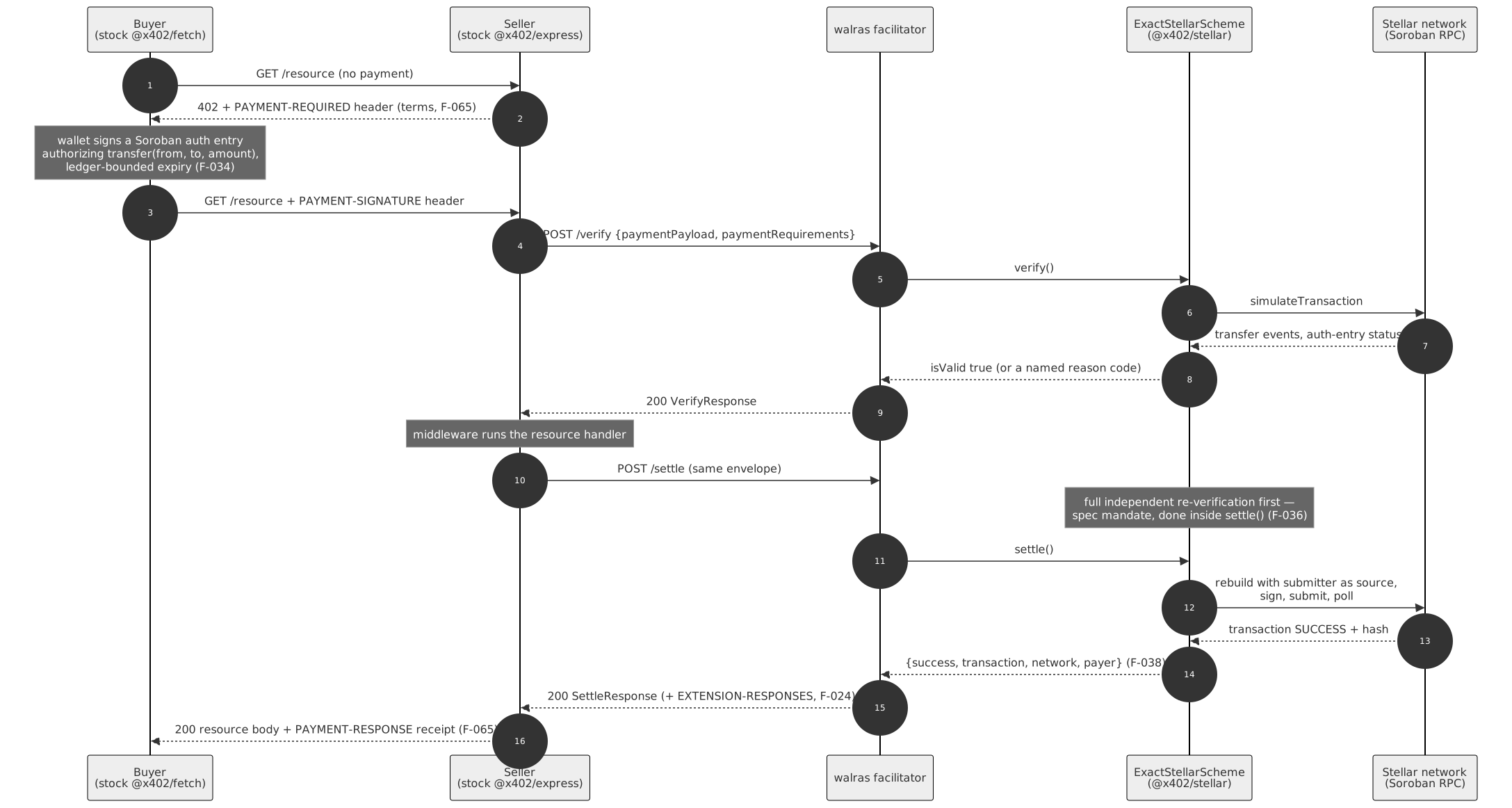
Source: diagrams/payment-settlement-sequence.mmd.
The full wire transcript of exactly this flow, stock client on both sides, is S2-2.
The path, with the load-bearing facts:
- The buyer's first request carries no payment; the seller answers 402 with
PaymentRequirementsin thePAYMENT-REQUIREDheader — the v2 canonical name (F-065). Requirements name the CAIP-2 network, the SEP-41 asset contract, the integer base-unit amount,payTo, andmaxTimeoutSeconds. - The buyer's wallet signs a Soroban authorization entry for exactly
transfer(from, to, amount)on the asset contract (F-033). Validity is ledger-bounded:ceil(maxTimeoutSeconds / estimatedLedgerSeconds)ledgers from now (F-034). - The seller's middleware POSTs
{x402Version, paymentPayload, paymentRequirements}to/verify(F-089). The scheme checks, in order: protocol shape, transaction structure (one operation, contract equalsasset,transferwith three arguments, recipient equalspayTo, amount exact as i128), facilitator safety, then enforcing-mode simulation, and only after simulation succeeds the auth-entry checks (credential type, no sub-invocations, all signers signed, expiry bound) and the transfer-event checks (F-035, F-064). Simulation is the cryptographic control, not defence in depth: the package's own signature check tests only that a signature is present, so a forged authorization is caught exclusively by the Soroban host during simulation (F-062). - On
isValid: truethe seller does its work, then POSTs the same envelope to/settle. Settle re-verifies in full — a spec mandate executed inside the scheme's ownsettle()(F-036) — so walras runs no wrapper-level pre-verify, which would double every simulation and add no safety. - The scheme rebuilds the transaction with a walras submitter as source (the buyer's
signed auth entry rides along unchanged), derives the fee from a fresh settle-time
simulation plus an inclusion buffer, fully overriding the client's fee bid, under a
configurable ceiling of 50 000 stroops (F-037), signs, submits, and polls to a
terminal state. The receipt is
{success, transaction, network, payer}(F-038). - The seller returns 200 with the resource and forwards the receipt in
PAYMENT-RESPONSE(F-065).
HTTP status convention. A payment the scheme rejects is a 200 carrying
isValid: false or success: false with the reason code — a successful exchange about
an invalid payment, matching the reference facilitator. 4xx is reserved for requests
that could not be interpreted as an x402 exchange at all, and even those are rendered in
the protocol shape so a stock client's error path keeps the machine-readable code.
/supported is served straight from the package: kinds, extensions, and
signers, all three required (F-040). The Stellar kind carries
extra.areFeesSponsored: true, byte-identical to both independent public operators'
captures (F-041, F-090), and a test asserts it against the captured baseline value.
Throughput posture. Stellar serializes submissions per source account by sequence
number, and agent traffic is bursty. The package already ships the two mechanisms the
reference operator runs in production (D-012): SUBMITTER_SECRET accepts a
comma-separated list and settlements rotate across submitters (F-044) — observed live
with source_account alternating SUB1/SUB2/SUB1/SUB2/SUB1 across five consecutive
settlements at a median 5.18 s settle latency (F-095, S7-2) — and
FEE_BUMP_SECRET wraps each settlement in a fee-bump transaction so fee payment is
decoupled from sequence management (F-047), observed live at exactly the predicted
100-stroop premium (F-086, S7-1). The composed posture — rotation and fee
bump in one run — has not been captured; each half has.
PLANNED: T1 the production submission layer, which the pre-build demonstrates the
mechanism for but does not manage: a channel-account pool sized to observed load
(accounts that exist only to supply sequence numbers, leased with a TTL, quarantined on
any submit error, reconciled against the ledger before return, and checked at boot —
mismatch refuses to start); a durable settlement table keyed on (signer, nonce, contract) so the auth-entry nonce is both the replay defense and the idempotency key,
giving lost-RPC-response recovery by hash lookup instead of blind resubmission; and RPC
failover across two providers health-checked on ledger freshness, with disagreement
treated as an alarm rather than a routing choice. As built, a process that dies between
submission and response leaves recovery to the operator's Horizon walk
(runbook §7) — stated, not hidden.
4. Assets, trustlines, fees, and amounts#
- Scope is SEP-41 Soroban tokens only; classic Stellar assets are not supported by
the scheme (F-033). USDC is the documented default with seven decimals, and
amounts are integer base-unit strings end to end (F-008). The testnet USDC contract
CBIELTK6…DAMAwas verified four independent ways — spec, package constant, on-chain ledger entry, and cryptographic re-derivation from the classic asset (F-052). The mainnet constant is taken from the package and has not been independently verified on pubnet (F-053). - Trustlines are the seller's onboarding concern. A classic
G…recipient needs a USDC trustline before it can receive, and each trustline raises the account's minimum balance by one base reserve of 0.5 XLM — invisible on testnet, real on pubnet (F-085). walras creates no trustlines and bypasses no issuer controls; the demo'ssetup-accounts.mjscreates them for the demo accounts, and the sell guide covers the rest. - Fee sponsorship covers the network fee only. The buyer never spends XLM or a sequence number (F-006); the facilitator's submitter holds no USDC at any point (S2-3). The fee is not in the receipt — it is an on-chain fact read back from Horizon: 22 973 stroops on the single-submitter path (F-069), 23 073 on the fee-bump path (F-086). Versus the default 50 000-stroop ceiling, that is roughly 2× headroom (F-037).
- Amount is exact, not "at least".
wrong_amount,wrong_recipient, andwrong_assetfire before any network call (F-064). - Expiry is ledger-bounded (F-034). One inherited deviation, disclosed rather than forked away: the package tolerates expiry two ledgers beyond the spec's strict bound to absorb RPC skew (F-046, D-008).
stellar:pubnetis configuration-supported, never exercised. Pubnet has no public default RPC, soRPC_URLis required there (F-004); every settlement on this page is testnet.
5. Error model#
Four disjoint taxonomies, 65 codes, all rendered into the generated error registry:
| Taxonomy | Count | Where it appears |
|---|---|---|
| Inherited scheme codes — verify path | 30 | invalidReason on /verify and, because settle re-verifies, on /settle |
| Inherited scheme codes — settle path | 7 | errorReason on /settle |
walras_* envelope codes |
10 | malformed bodies, unsupported kinds, unknown routes, query interpretation — before the scheme is consulted |
bazaar_* soft-drop codes |
7 | the bazaar object in EXTENSION-RESPONSES on /settle |
walras_mcp_* tool codes |
11 | {errorCode, reason} results from the MCP server |
The 37 inherited codes pass through verbatim and are never shadowed or renamed
(D-007). The package populates a human-readable message on exactly one of its paths, so
walras backfills the rest — that is what makes "non-null reason on every rejection" true
by construction. A test greps the installed package bundle for its reason-code
literals and fails if the set differs from the enumeration, so an upstream rename breaks
the build instead of silently degrading a rejection (F-063). Stock consumers see the
codes: the stock facilitator client parses EXTENSION-RESPONSES and logs
status, rejectedReason, and the additive machine code (F-073, D-014).
6. Bazaar: settle-gated cataloging#
The Bazaar is an off-chain index derived from seller-declared metadata, and that is a design position: an on-chain registry adds rent that must be extended or entries evict, and per-payment anchoring roughly doubles settlement cost, for a property discovery does not need — a poisoned catalog entry costs an agent one wasted request, never funds, because the payment itself is independently bound to recipient, asset, and amount inside the signed authorization (F-033). Decentralization comes from replicability (§10), not from a registry contract.
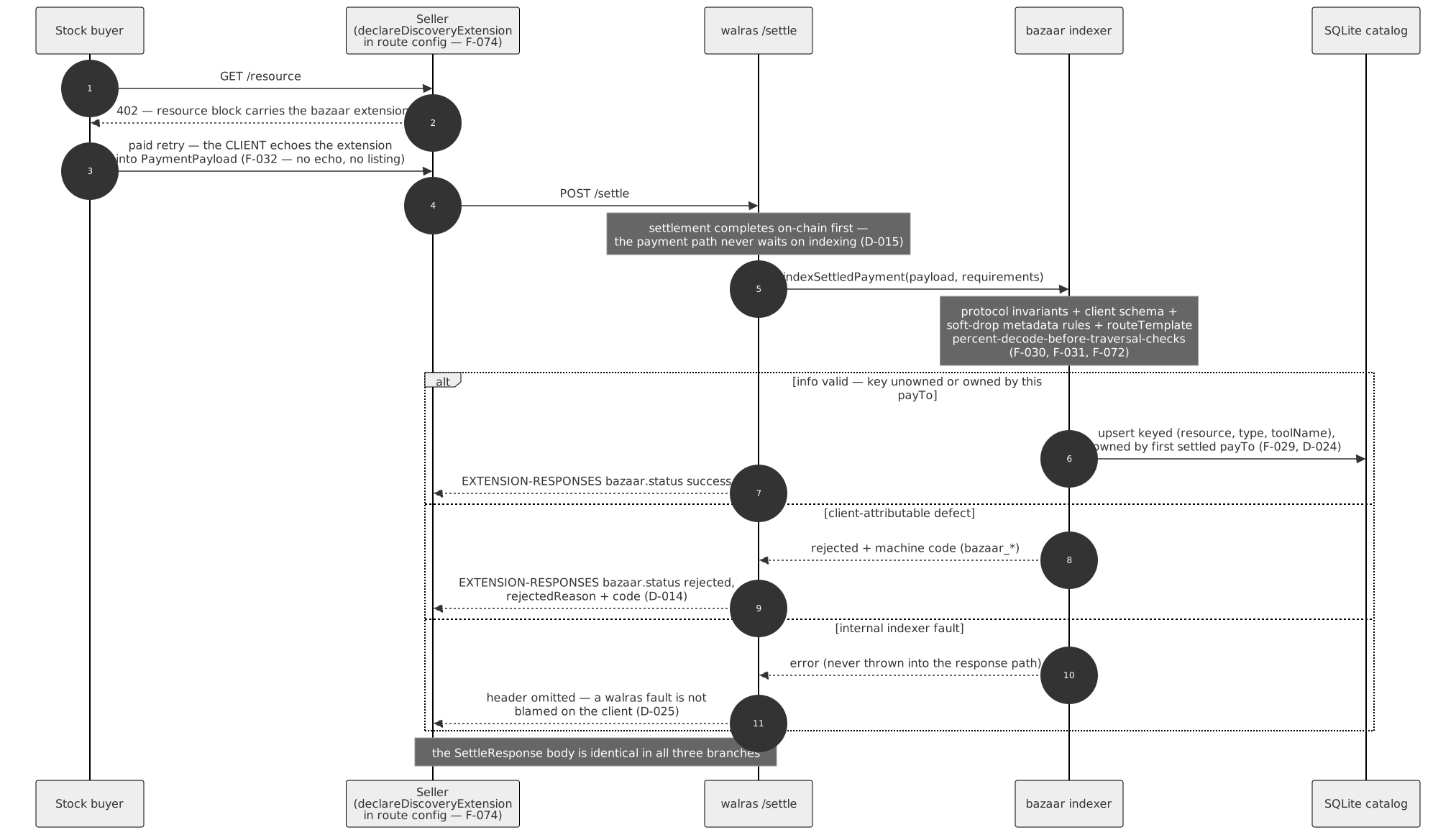
Source: diagrams/auto-catalog-sequence.mmd.
Proven live: pay → listed with zero registration (S3-3); hostile writes
soft-dropped while their settlements succeeded (S3-4).
Listing is settle-gated, and that is policy, not conformance. The spec does not require cataloging to be gated on settlement (F-023); walras gates it deliberately (D-004) because a listing that costs a real on-chain settlement is the cheapest anti-spam control that needs no accounts, no reputation, and no moderation — and it is why no registration endpoint exists (D-022). The seller cannot force a listing either: if the client omits the echoed extension, nothing is cataloged (F-032).
Identity. HTTP resources are keyed on the canonical URL — origin + routeTemplate
when the seller declared a valid template, else origin + pathname, query and fragment
stripped (F-051). MCP tools are keyed on the tuple (resource.url, input.toolName), a
spec MUST because one MCP endpoint multiplexes many tools (F-029); the reference e2e
catalog keys on URL alone and lets two tools overwrite each other, a defect walras
deliberately does not share (D-009). Every listing is owned by the payTo of the
first settled payment that created it — the only client-independent identity signal
in a settle-gated catalog, because the scheme verified on-chain that the transfer
credits it (D-024). Same key and same owner refresh the listing; a different owner is
rejected bazaar_listing_owned_by_other_payee inside one BEGIN IMMEDIATE
transaction, so two concurrent settlements cannot race the check.
The indexing invariant has a mechanism, not a promise (D-015, D-025):
- The settle response is produced from the chain result alone; the hook runs afterwards and never throws by contract, with a belt-and-braces catch in the route.
- Its work is structurally bounded: a 64 KiB cap on the extensions block before any validation touches it, regex-bearing schema keywords stripped and a node-count cap applied before Ajv compiles anything (a ~140-byte evil-pattern schema measured 36 s of synchronous compute in the SDK's own validator — F-087, D-033), a 100 ms database busy timeout, and a 250 ms soft budget that logs a warning.
- Its outcome only decorates the response:
success, orrejectedwith a human-readablerejectedReasonplus a machinecode(F-024, D-014). Field-level defects —serviceName,tags,iconUrl,routeTemplate— drop the field and keep the listing, and are recorded in asoft_dropsaudit table (F-031, D-033).
The trust boundary. Clients echo the resource block into the payment payload, so every byte of it is hostile until validated, and the SDK's one-shot extractor is explicitly not that boundary — it validates only against the client-supplied schema and never calls the protocol-invariant check (F-072). walras composes the low-level validators itself:
| Threat | Control as built | Exercised by |
|---|---|---|
| Poisoning via a trivial client schema | Protocol-invariant validation in addition to client-schema validation; either failure soft-drops with a code (F-072) | Unit (S3-2); live garbage extension → bazaar_spec_validation_failed, settlement untouched (S3-4) |
| Overwriting another seller's listing with a real settled payment | Owner binding to the settled payTo (D-024) |
Live wrong-payee settlement → bazaar_listing_owned_by_other_payee, listing byte-identical after (S3-4); the same on the MCP tuple against Policywright's listing (F-094, S6-4) |
Traversal or scheme-smuggling hidden in routeTemplate |
The SDK decodes once, so %252e%252e, //host, and %00 pass it (F-088); walras adds bounded repeated decode and rejects null bytes, backslashes, and protocol-relative forms before the SDK check (D-033) |
Poisoning suite incl. the double-encode and null-byte cases the SDK alone would pass (S3-2) |
| Regex denial of service through the client's schema | Regex keywords stripped, node budget applied before compilation; over-budget schemas soft-drop bazaar_schema_too_complex (D-033) |
The evil-pattern schema now indexes in under a second (S3-2) |
| Hostile service metadata — oversized names, tag floods, dangerous icon hosts | Per-field soft-drop rules with percent-decode before IP and loopback checks (F-031) | Metadata suites (S3-2) |
| Two MCP tools on one URL colliding | Tuple keying (F-029) | Live: an MCP tool cataloged beside the HTTP listing on the same origin (S6-3) |
Disclosed limitations, stated as limitations:
- URL squatting is not prevented. A settled payment carries no proof that its
payTocontrols the echoed origin, so whoever settles first for a key owns it, and the real seller's later honest settlement is rejected. An attacker-first regression test pins the real behavior rather than claiming a defense (D-032). Blast radius is bounded by design — the catalog'sacceptsis advisory and a protocol-following buyer always pays against the live 402 from the resource server itself, so a squat pollutes metadata and denies a listing but cannot redirect funds. PLANNED: T1 proof-of-origin-control at index time. - Micro-settlement spam is priced, not prevented. A self-paying attacker sets its own price and the operator bears the sponsored network fee (~0.0023 XLM, F-069); nothing prunes stale listings yet, and the reference operator's 30-day rule (F-012) is noted, not adopted. PLANNED: T1 configurable caller authentication, rate limits, and a retention policy.
- Federation across independently operated catalogs is an interop direction, not a delivered feature.

Source: diagrams/payment-lifecycle-state.mmd.
Every terminal state carries a non-null reason; everything below Settled runs off the
settlement path and cannot change its outcome (D-015).
7. Search and its evaluation#
GET /discovery/search is spec-shaped end to end: the required parameter is query,
not q (D-006); the same filters as the list endpoint; a resources array where the
list endpoint returns items — an asymmetry the SDK types define and a stock
withBazaar client depends on (D-001); an explicit partialResults that means exactly
"matches were truncated" (D-027); and real keyset cursor pagination although the spec
makes it advisory and no reference operator implements it (D-003, F-013).
pagination.limit is the count in this page, not the requested maximum (F-077).
The pipeline is a Retriever — a one-method seam, query → ranked ids + scores —
whose ranking the shared filter semantics intersect and the cursor slices. Ranking can
therefore change without touching the wire contract, the filters, or pagination.
BASELINE retriever LIVE. The pre-build ships exactly one implementation, labeled
BASELINE in code and documentation (D-026): SQLite FTS5 with BM25 over four weighted
fields — service name 4.0, description 2.0, parameter text 1.0, tags 3.0 — with the
weights rule-of-thumb and explicitly untuned. Parameter text is parameter names plus
JSON-Schema description annotations; example values are deliberately not indexed,
because an example city of "Zurich" says nothing about what a resource does. Untrusted
queries are compiled to quoted-token OR expressions, since raw FTS5 syntax throws on
operator characters (F-076). There is no stemming, no stopword handling, and no synonym
expansion — and the evaluation set contains queries chosen to fail on exactly those
gaps.
Evaluation is the deliverable that keeps ranking honest. pnpm eval:search builds
a fixture catalog from eval/search/corpus.json through the production indexing
path, runs the 28 labeled queries in eval/search/queries.json, and reports
(S4-3, independently reproduced in a clean clone in S5-1):
| Metric | BASELINE |
|---|---|
| recall@1 | 0.839 |
| recall@3 / recall@5 | 0.929 / 0.929 |
| MRR@10 | 0.911 |
| nDCG@5 / nDCG@10 | 0.909 / 0.909 |
| zero-result queries | 0 of 28 |
The misses are the planted vocabulary-gap probes — "US dollars to euros" against a
corpus that says USD/EUR, "did it snow" against "snowfall", "apple share price" ranked
behind crypto prices — and they are the measured acceptance tests for the upgrades
below (S4-3). The harness is wired into CI as a regression gate: a run
whose nDCG@10 falls more than 5 % below the committed
baseline.json fails the build, and so does a corpus
hash change, so the baseline can only move deliberately, alongside the retriever change
that moves it.
Ranking neutrality as built. The BASELINE ranking function's only inputs are the query and the four indexed fields (D-026). There is no listing attribute — house-owned or otherwise — that the retriever can read, so operator preference has no channel to express itself. When settlement-derived quality signals arrive (PLANNED: T2 distinct buyers, volume, recency, metadata completeness, ordering results after relevance retrieves them), a neutrality test will assert that flipping a display-only house flag changes zero orderings across the golden set.
PLANNED: T2 the ranking upgrade path, in measurement order, each step landing only
if it moves the harness's numbers: lexical hygiene (stopwords, light stemming) → hybrid
retrieval (BM25 fused with dense embeddings computed at index time, reciprocal rank
fusion first because it needs no calibration between incomparable score scales and
degrades gracefully when one retriever returns nothing) → cross-encoder re-ranking over
the fused top-k. An embedding-provider outage returns lexical results with
partialResults: true, never an error, and a self-hosted instance boots and searches
with no model credentials at all. The golden set grows from the real catalog with graded
judgments and a published methodology; the gate is kept honest by a committed,
deliberately regressing fixture, because a gate nobody has watched fail is a gate nobody knows
works — the vocabulary-gap misses recorded in S4-3 are the first such fixture. Online signals never create relevance labels and never rewrite seller-authored
text: seller metadata is the only source of catalog claims.
8. MCP: discover, pay, retry#

Source: diagrams/discovery-agent-flow.mmd.
Proven live with a generic MCP client carrying zero walras and zero @x402/* imports
(S6-3).
Two tools over stdio, and the whole discover → pay loop behind them. @x402/mcp
supplies the payment-aware client and the server-side tool wrapper and nothing else — no
discovery tools, no MCP→HTTP bridge, no catalog resolution — so the tools, the bridge,
and the id scheme are entirely this repository's build (F-080):
search_resources(query, filters?)— ranked catalog search through the facilitator's public/discovery/search. Each hit carries a deterministic, self-describing id —wr1:plus a base64url encoding of the listing tuple, minted identically on every server and re-resolved against the live catalog before any payment (D-029) — the price in base units, the network, and the machine-readable calling convention: method and example values for HTTP, the inlineinputSchemafor MCP (F-082).paid_call(resourceId | url [+ toolName], input?)— resolves the target, probes its live 402, applies the spend policy, pays through the stock client path (@x402/fetchfor HTTP, the@x402/mcpclient for tools), and returns the result plus a receipt{transaction, network, payer}.
Every failure is a structured {errorCode, reason} tool result — never a thrown
free-text error — with facilitator codes passed through verbatim and dual-format
content per the MCP transport spec (F-079, D-028). Live in the same session:
walras_mcp_unknown_resource_id for a stale id and the facilitator's own
walras_invalid_search_cursor surfacing unchanged through the tool (S6-3).
Spending is bounded twice. The per-call cap (WALRAS_MCP_MAX_AMOUNT, default
1 USDC) binds as a pre-payment check against the probed 402 and as a
registerPolicy filter on the one shared x402Client, so a fresh 402 with a raised
price hits the policy even though the pre-check saw the old one; foreign-network
demands are declined the same way, and tests assert the paying seam is never invoked on
a declined call (F-081, D-030).
Key posture, as built. The MCP server is a local component that runs beside the
agent. It pays only when CLIENT_STELLAR_PRIVATE_KEY is set in its own environment;
unset, it runs search-only and paid_call names the gap (D-030). Nothing about it is
hosted, and it consumes only the facilitator's public endpoints — it never imports
facilitator internals or opens the catalog database (F-080). Smart-account payers
compose at the signer: the facilitator path is address-type-agnostic and a contract
account's __check_auth executes inside enforcing-mode simulation, so custom policies
never need to be disclosed to walras; the blocker for a live contract-account run is
client-side payload creation in the package, traced but not executed (F-096).
PLANNED: T2 a hosted, keyless discovery profile at mcp.walras.space (its DNS
record is not created before it ships — a resolving host that returns nothing is worse
than NXDOMAIN) and an auth-entry-shaped signer interface so an Ed25519 keypair and a
smart-account wallet travel the same client-side path.
The acceptance case is a tool that is not ours. Policywright (SCF #44) exposes a
pure synthesize capability — recorded Soroban transaction in, least-privilege
OpenZeppelin smart-account policy out, no I/O and no clock reads, so a paid call is
deterministic. It is served as a paid MCP tool behind walras using only the stock SDK
(createPaymentWrapper, F-080). A generic MCP agent with zero prior integration
searched (empty — pay-to-list), paid the tool by (url, toolName), and that settlement
cataloged it; the agent re-found it and paid it again by minted id, with byte-identical
output and fees of 22 973 stroops each (F-093, S6-4). An attacker echoing the
tool's exact tuple with its own payTo settles on-chain and is rejected
bazaar_listing_owned_by_other_payee, the listing untouched (F-094). Scope stated
plainly: the integration lives in Policywright's repository, walras imports nothing from
it, and it is one early tool — not Policywright's own MCP-server deliverable (D-037).
9. The upto scheme#
Status: PLANNED: T2 — design, not implementation. @x402/stellar implements the
exact scheme only, and no Stellar upto specification exists at the pinned commit
(F-005). No upto code exists in this repository. What follows is the design the grant
delivers, with its assumptions named.
exact fixes the amount at signing time; metered services — token billing, bandwidth,
compute — need "authorize up to a cap, settle actual usage". On Stellar this requires a
contract, and the reasoning is structural. A Soroban authorization commits to the
exact invocation arguments, so a signed direct transfer is a fixed amount. The obvious
contract-free primitive, a SEP-41 allowance plus transfer_from, genuinely provides a
cap and a ledger-bounded window but fails two mandatory properties: it binds
(from, spender) and an amount, not a recipient, and a standing allowance is
drawable again — a facilitator could split it across settlements or direct value to
a recipient the buyer never named, and nothing on-chain would distinguish that from
honest metering. That is the trust gap the RFP itself names, and any contract-free
design must state it as a weaker trust profile rather than engineer around it with
assertions (litepaper §8).

The contract is deliberately minimal: single-function, no administrator, no upgrade
path, no application-defined persistent storage, and it never holds a balance. The
client signs one authorization via require_auth_for_args over the bound argument list
— ceiling, recipient, token, time bound — deliberately excluding the actual amount,
which is supplied at settle time and enforced actual ≤ ceiling in contract logic; the
Soroban host nonce and the ledger deadline give single use and time bounding. Three
rejection rules define the scheme and are what its acceptance tests check: a payload
whose signed root includes the actual amount is rejected (that is exact, not upto);
a settlement targeting any contract other than the address advertised in /supported
is rejected at the operation level, before anything else is considered; and above-ceiling
and replayed payloads are rejected at the contract, not merely at the facilitator —
the contract must be safe against a malicious facilitator, which is the entire reason it
exists. Facilitator-side validation for the scheme is new security-critical code with
its own shape checks and its own error codes.
Composition with smart-account spending policies. The signed tree exposes ceiling,
recipient, and token, so an account policy can enforce per-window budgets and
allow-lists across any facilitator: the account caps total outflow, the contract caps
this settlement and binds its recipient — two independent limits with different trust
assumptions and no shared failure mode. The pre-build's client-side spend cap (D-030) is
the application-layer sketch of the same idea, and the facilitator path already executes
a contract account's __check_auth inside enforcing-mode simulation (F-096).
Named assumptions, resolved on testnet before the specification is finalized —
if reality differs, the spec changes, not the test: that the facilitator's auth-tree
shape checks accept the contract's require_auth_for_args tree; that the settlement fits
within Soroban resource limits under the facilitator's fee ceiling; and that the
contract's ledger-entry TTL covers the authorization's deadline window. The scheme's
audit scope is bounded to match: one function, no storage, no custody, reviewed
separately from the off-chain service. scheme_upto_stellar.md is authored alongside
and contributed upstream through the x402 Technical Steering Committee (F-016).
batch-settlement and auth-capture are deferred per the RFP and not foreclosed —
scheme dispatch is a table, not a rewrite.
10. Deployment and configuration#

Source: diagrams/deployment-topologies.mmd.
The footprint is one process and one file. A facilitator instance is a single
Node.js process plus one SQLite file for the catalog — no external database, no message
queue, no proprietary cloud dependency (D-023). The only credentials it holds are its own
Stellar submitter seed(s), supplied by environment variable and never echoed in errors,
logs, or /health, which carry public addresses only (THREAT-MODEL §1).
Every capability on this page was exercised on exactly this footprint against the public
testnet RPC (S2-2 through S6-4).
- Hosted — one operator runs walras for many sellers; the shared catalog is the point, and every transcript in the evidence ledger runs this topology (D-004). Nothing about the protocol privileges the hosted instance, and there is no public hosted facilitator yet — the walras.space Browse page ships its empty state rather than specimen data (D-039).
- Self-hosted — the same code, run by anyone:
git clone, setSUBMITTER_SECRET, start (runbook). Apache-2.0 with a copyleft-free dependency path is what makes this real rather than nominal (F-060, D-031). A self-hosted instance catalogs what settles through it. - Self-facilitation inside a resource server — PLANNED: T1. The seam exists as
built:
buildServertakes injected configuration and store, and the test suite drives the whole app in-process with no socket; the packaged embedding mode (verify/settle/discovery mounted inside an Express or Fastify resource server, sharing the catalog store) does not ship in the pre-build.
Configuration fails closed. Invalid configuration exits with EX_CONFIG (78)
before a port is bound, naming the variable — a facilitator that starts on half-valid
configuration would advertise capability it cannot honour. The full table is generated
from the in-code CONFIG_REFERENCE and drift-tested: configuration reference.
The facilitator surface is NETWORK, RPC_URL (required on pubnet, F-004),
SUBMITTER_SECRET (one seed or a comma-separated list), FEE_BUMP_SECRET, PORT,
FEE_MODE (only free is implemented; anything else is a startup error, distinct from
areFeesSponsored, which is about network fees and always true — F-006), DB_PATH, and
MAX_TRANSACTION_FEE_STROOPS (F-037). The MCP server adds FACILITATOR_URL,
WALRAS_MCP_NETWORK, WALRAS_MCP_MAX_AMOUNT, and CLIENT_STELLAR_PRIVATE_KEY (D-030).
PLANNED: T1–T3 caller authentication, rate windows, sponsorship budgets, channel-pool
sizing, retention, RPC failover thresholds, metrics and tracing exporters, and alert
thresholds — required delivery controls, not represented as already-implemented keys.
Continuous integration has a live half. ci.yml runs
the single-SDK assertion (two copies of the Stellar SDK produce XDR objects that fail
instanceof across the boundary — F-059, D-013), the two-tier license gate, build,
typecheck, all suites, the search regression gate, and the docs gate.
live-settle.yml then proves the money movement:
on every push it creates throwaway accounts through Friendbot, buys testnet USDC on the
DEX with no captcha faucet, and runs the demo's happy path — a stock buyer pays a stock
seller through walras and the settled hash lands in the job summary. The repository holds
no secrets, which is what makes the settlement reproducible by any fork.
The documentation site sits outside the gates, by design. docs.walras.space is
deployed manually; the commit stamped in every page footer is the authority on what a
reader is looking at, and pnpm check:site compares it against the tree — deliberately
not in CI, because a stale deploy is an ops condition, not a broken commit (F-092, D-035).
PLANNED: T1–T3 the hosted production shape, stated as design rather than described as operated: SQLite remains the self-host default while the hosted deployment moves settlement state to PostgreSQL — the idempotency and recovery table, where a dropped write would be a double-spend of the buyer's authorization and durability beats latency — with pgvector added when semantic retrieval lands; Redis for channel leases and rate limits, ephemeral by design, so losing it costs a pool reconcile and never correctness; a public-readable object store for CI transcripts as the evidence trail; two Soroban RPC providers with divergence alarms; the treasury key in a KMS with a documented rotation drill, channel accounts sponsored from it; and a published SLO only after there is measurement history behind it. The hosting provider, monitoring stack, and mainnet RPC choice are not yet stood up.
11. Threat model#
The threat model follows the four questions of the
Stellar threat-modeling guide
and its STRIDE template; the full STRIDE-lite table with a test or transcript per
control is THREAT-MODEL.md. Status: testnet, unaudited.
What are we working on. The data-flow diagram is the trust-boundary map below. Everything in the top box is client-controlled and hostile until validated (F-072).

Source: diagrams/trust-boundaries.mmd.
Assets worth protecting, in order: the submitter seeds (the only credential an instance
holds); the operator's XLM, which sponsors every settlement; the correctness of the
buyer's authorization — walras never holds buyer funds, but a verification bug could let
a payment settle that should not; the catalog's integrity, meaning listing identity and
seller-authored text; and the availability of the payment path, which cannot exceed the
availability of the Soroban RPC. Entry points: /verify and /settle (a client-built
transaction plus auth entries), the echoed discovery extension on /settle, the
discovery query strings, and the MCP tool arguments.
What can go wrong, and what is done about it — the highest-severity rows, in the
template's Category.# form, each mapped to the monitor in §12
that detects it:
| ID | Threat (STRIDE) | Control as built | Exercised by | Monitor |
|---|---|---|---|---|
| Tamper.1 | Forged or altered authorization signature | Enforcing-mode simulation is the sole cryptographic control; the package checks presence only (F-062, F-035) | Modelled with real Ed25519 verification (S1-4); live collapse to …_simulation_failed (S2-6) |
M7 |
| Tamper.2 | Requirements tampered — amount, recipient, or asset differ from what the client signed | Pre-simulation argument equality; wrong_amount and siblings fire before any network call (F-064) |
Live amount mismatch (S2-6); demo --tampered (S5-3) |
M7 |
| Spoof.1 | Replay of a settled payload | Structural: the auth-entry nonce is consumed on-chain, re-simulation fails (F-039, D-011); no application replay cache exists, deliberately | Live replayed payload rejected at /settle (S2-6) |
M7 |
| Tamper.3 | Expiry race — an entry used past its ledger bound | Ledger-bounded expiry derived from maxTimeoutSeconds (F-034); two-ledger inherited tolerance disclosed (F-046, D-008) |
Live expired entry rejected on both routes (S2-6); demo --expired (S5-3) |
M7 |
| Elev.1 | Front-running — an observer lifts the signed entry to redirect or drain it | Recipient, amount, and asset sit inside the signed preimage (F-033); one nonce, one settlement (F-039); the facilitator refuses to be source, payer, or auth participant (F-035) | Reduces structurally to the wrong_* fixtures (S1-2) and the replay test (S2-6) |
M4 |
| DoS.1 | Fee-bid manipulation to drain the sponsor | Client fee bid fully overridden from a fresh settle-time simulation under a hard ceiling (F-037) | Ceiling code in the fixture suite (S1-2); fees measured 22 973 / 23 073 stroops (F-069, F-086) | M1, M2 |
| DoS.2 | Free /verify simulation as a denial-of-service vector; sponsor drain by volume |
Not yet controlled — no caller authentication or rate limiting exists (RFP 3.1 leaves the mechanism to the operator) | — | M12, M13 PLANNED: T1 |
| Tamper.4 | Catalog poisoning through a trivial client schema | Protocol invariants validated in addition to the client schema (F-072) | Unit (S3-2); live (S3-4) | M9 |
| Spoof.2 | Overwrite of an existing listing by a different payTo |
Owner binding to the settled recipient, transactional check-and-write (D-024) | Live on HTTP (S3-4) and on the MCP tuple (F-094) | M11 |
| Spoof.3 | URL squatting — claiming a URL before its owner ever settles | Not prevented; disclosed (D-032). Blast radius bounded because the catalog is advisory | Attacker-first regression test pins the real behavior (S3-2) | M11 |
| Tamper.5 | Hostile routeTemplate — traversal or scheme-smuggling behind percent-encoding |
Bounded repeated decode plus null-byte, backslash, and protocol-relative rejection ahead of the SDK's single-decode check (F-088, D-033) | Poisoning suite (S3-2) | M9 |
| DoS.3 | Indexer as settlement hostage — a poisoned write stalling payments | Outcome decided before the hook; never throws; 64 KiB cap; regex keywords stripped and node count capped before Ajv (F-087, D-033); forced-failure test (D-015) | The evil-pattern schema indexes in under a second; settlement succeeds against a broken store (S3-2) | M10 |
| DoS.4 | FTS5 operator injection in query |
Queries compiled to quoted-token expressions; raw syntax never reaches the engine (F-076, D-026) | Live hostile-syntax probe returns ranked results (S4-4) | M7 |
| Tamper.6 | Cursor confusion or forgery | Context-binding integrity hash; mismatch is a named 400 (D-027) | Live exactly-once walk and invalid-cursor probe (S4-4) | M7 |
| Info.1 | Submitter seed disclosure | Seeds never echoed; /health and boot log carry public addresses only; .env gitignored |
config.test.ts asserts the invalid-seed error omits the value |
M5 |
| Elev.2 | Unbounded agent spending through paid_call |
Spend cap enforced twice — pre-payment check and client policy (F-081, D-030) | Over-cap and foreign-network demands declined with the paying seam never invoked (S6-2) | user-side |
| Repud.1 | A party denies a settlement | Every receipt carries the 64-hex on-chain hash (F-038); the ledger is the audit trail | Receipts re-verified against Horizon out-of-band (S2-3, S5-5, S6-3) | M3 |
| DoS.5 | Soroban RPC outage or staleness | No verify-only degraded mode by design — a verify that skipped simulation would approve payloads the scheme cannot vouch for; discovery keeps serving from local SQLite (runbook §6) | Real congestion event with full forensics: settle failed honestly after 30.5 s, no funds moved (S5-5) | M3, M6 |
Accepted risks, recorded: the two-ledger expiry tolerance (D-008); URL squatting
(D-032); the micro-settlement spam residual and the absence of retention
(§6); the experimental node:sqlite module
(D-023, F-070); and the open surface — no authentication or rate limiting yet
(operate guide §8).
Did we do a good job — the retrospective so far. The model is living, and it has already been wrong three times, each time recorded rather than quietly fixed: the "byte cap bounds Ajv cost" argument was falsified by a measured ReDoS in the SDK's validator, producing D-033 (F-087); the squatting exposure was stated as prose with no test and the honest-first ordering read as a stronger claim than the boundary supports, producing the attacker-first test and D-032; and a Session-0 baseline capture went untracked for twelve days, producing D-034 and the live capture that vindicated D-016 (F-091). The audit scope statement stands: v1 ships no new Soroban contract, so the review surface is an off-chain service and its cryptographic validation (THREAT-MODEL §4); a third-party review through the Audit Bank is PLANNED: T3 before any mainnet production tag.
12. Monitoring plan#
The monitoring plan is derived from the threat model — each STRIDE row above maps to a signal, a baseline, and a trigger — in the shape of the Stellar security team's monitoring examples: what a monitor detects, its severity, and who watches it. "Builder-side" monitors are for whoever operates a walras instance; "user-side" monitors are for sellers and agents protecting their own seat. Two columns matter most: baseline, because every one comes from a measurement in the evidence ledger rather than an assumption, and status, which separates the signals walras emits today from the alerting that is tranche-2 delivery.
Builder-side monitors — the whole aircraft. Each row names the threat it is derived from and the signal source:
| ID | Monitor (derived from) | Signal source and baseline | Trigger | Severity | Status |
|---|---|---|---|---|---|
| M1 | Submitter and fee-account XLM balance (DoS.1, DoS.2) | Horizon. Baseline: 22 973 stroops per settlement single-submitter, 23 073 fee-bump (F-069, F-086); pnpm preflight flags under 1 XLM |
Balance below N settlements of runway, N configurable | Critical | Balance check in preflight today; alert PLANNED: T2 |
| M2 | Fee charged per settlement (DoS.1) | Horizon fee_charged. Baseline: exactly 22 973 or 23 073 stroops on every settlement captured to date (F-069, F-086); ceiling 50 000 (F-037) |
Any settlement outside the two known values, or within 20 % of the ceiling | Warning | Manual Horizon walk today (S2-3 procedure); metric PLANNED: T2 |
| M3 | Submitter transaction-failure rate (Repud.1, DoS.5) | Horizon with include_failed=true; facilitator settle_exact_stellar_transaction_failed and …_submission_failed counts. Baseline: zero failed on-chain transactions across every captured run; one honest settle failure under congestion with nothing reaching the ledger (S5-5) |
Any failed on-chain transaction, or settle-failure rate above 5 % over 15 minutes | Critical | Manual today (runbook §7); metric and alert PLANNED: T2 |
| M4 | Non-custody invariant on-chain (Elev.1) | Horizon balances and operations for every submitter. Baseline: submitters hold no USDC and no USDC trustline; every settled transfer has from = the buyer, never a submitter (F-035, S2-3) |
Any payment-asset balance or trustline on a submitter; any settled operation with a submitter as from |
Critical | Invariant enforced pre-settlement by the scheme; on-chain watcher PLANNED: T2 |
| M5 | Submitter signer or threshold change (Info.1) | Horizon set_options on watched accounts. Baseline: no signer changes outside a documented rotation (runbook §4) |
Any signer, threshold, or home-domain change | Critical | PLANNED: T2 |
| M6 | RPC ledger freshness and provider divergence (DoS.5) | Soroban RPC getLatestLedger vs Horizon. Baseline: testnet ledger cadence about 5 s (F-034 fallback estimate) |
RPC latest ledger more than 6 ledgers behind Horizon, or two providers disagreeing beyond normal lag — an alarm, not a routing decision | Critical | PLANNED: T1 with RPC failover |
| M7 | Rejection-code distribution (Tamper.1–3, Spoof.1, DoS.4, Tamper.6) | Facilitator logs, by code. Baseline: codes reachable live are the pre-simulation set plus …_simulation_failed (F-064); a healthy instance shows a low, stable rejection mix |
A single code's share rising more than 3× its trailing baseline — a spec change, a client bug, or an attack | Warning | Request logs today; failed settle bodies are not logged — the diagnosability gap recorded in S5-5; per-code metric PLANNED: T2 |
| M8 | Settle latency p50 / p95 (DoS.5) | Facilitator responseTime on POST /settle. Baseline: 3.4–7.2 s, median 5.18 s (S7-2); 6–18 s typical, 30.5 s congestion outlier (S5-5) |
p95 above 20 s over 15 minutes | Warning | Per-request timing in logs today; aggregation PLANNED: T2 |
| M9 | Soft-drop rate by reason code (Tamper.4, Tamper.5) | soft_drops table and indexer warnings; EXTENSION-RESPONSES rejected outcomes. Baseline: near zero from honest stock sellers (S3-3); each hostile fixture produces exactly its expected code (S3-4) |
Rate spike, or any bazaar_schema_too_complex |
Warning | Table and warn logs today (D-033); metric PLANNED: T2 |
| M10 | Indexing budget violations (DoS.3) | Indexer warn on the 250 ms soft budget; 100 ms busy-timeout failures. Baseline: zero in captured runs | Repeated warnings within an hour | Warning | Warn logs today (D-025); alert PLANNED: T2 |
| M11 | Ownership conflicts and catalog churn (Spoof.2, Spoof.3) | bazaar_listing_owned_by_other_payee count; listing creation rate; pagination.total. Baseline: conflicts only from the scripted attacks (S3-4, S6-4); the catalog grows by real settlements |
Conflicts against one key from many payers — a squatting or poisoning campaign; creation-rate spike from one payer — spam | Warning | Header outcomes and logs today; metric PLANNED: T2 |
| M12 | Sponsored-fee spend rate (DoS.2) | Facilitator settlement counter × measured fee (F-069). Baseline: bounded by settlement volume | Spend rate over a window above threshold trips a circuit breaker that stops accepting new settlements with a named reason | Critical | PLANNED: T1 with sponsorship budgets |
| M13 | /verify request rate by source (DoS.2) |
Facilitator request logs. Baseline: none yet | Rate above the configured window, independently of settle | Warning | PLANNED: T1 with rate limiting |
User-side monitors — your seat:
| Who | Monitor | How | Trigger |
|---|---|---|---|
| Seller | Listing outcome on every settlement | The stock middleware already logs EXTENSION-RESPONSES status and code (F-073) |
Any rejected — and specifically bazaar_listing_owned_by_other_payee for your own URL, which means someone else owns your listing (D-032) |
| Seller | Receipts against the ledger | Query Horizon for your payTo and reconcile against the PAYMENT-RESPONSE hashes you forwarded (F-038, F-065) |
A receipt whose hash is absent from the ledger, or a credit with no matching receipt |
| Seller | Trustline and reserve headroom | Horizon account balances (F-085) | Missing USDC trustline, or XLM below the reserve needed to add one |
| Agent operator | Spend against the cap | paid_call declines over-cap 402s before signing (D-030); receipts carry the hash |
Any walras_mcp_payment_declined_by_policy — a seller re-priced above your cap; any receipt hash absent from the ledger |
| Agent operator | Settle-failed re-402 | The stock middleware re-402s the buyer on success: false, and no funds move (S5-5) |
A second 402 for the same request — retry, do not assume a charge |
What walras emits today versus what the tranche delivers. As built, the facilitator
emits Fastify request logs (method, url, statusCode, responseTime), indexer
warnings on failures and budget violations, the soft_drops audit table, /health with
the public configuration (network, RPC, submitter addresses, fee-bump address, port, fee
mode, ceiling), and the settled hash and Horizon fee in the demo's output; every on-chain
row above is checkable by anyone with curl against Horizon. PLANNED: T2 a metrics
exporter for M1–M11, structured log fields carrying the reason code on every
rejection including failed settle bodies (closing the S5-5 gap), alert rules for every
Critical row, and — the tranche's acceptance criterion — each Critical alert
demonstrated firing against the live testnet deployment by fault injection, with the
transcript in the evidence ledger, because an alert nobody has watched fire is
decoration. PLANNED: T3 a public observatory that reads the ledger for
walras-facilitated settlements and publishes aggregates only — settlement counts,
distinct payers, catalog size, latency percentiles by network and scheme — never
per-payer data, every figure independently derivable from public ledger data.
13. Testing and conformance#
Acceptance is tested at the wire and ledger levels, not inferred from unit coverage.
- Hermetic suite. 225 tests at the time of writing — bazaar 76, facilitator 99,
mcp-server 50 — drive the Fastify app through
injectwith no socket and the MCP server through real in-memory MCP transports; configuration is passed explicitly, so the suite needs no.envand no secrets. The route schemas attached inserver.tsare documentation-grade — no-op validator and serializer compilers keep runtime behavior identical to a schema-less app, which the behavioral suite pins. - The Soroban RPC double, labeled. Because the scheme reaches its auth-entry and transfer-event checks only after simulation succeeds (F-064), those codes are unreachable against a live network in a hermetic suite. An in-process JSON-RPC double verifies auth-entry signatures for real — Ed25519 over the CAP-46 preimage — and synthesizes transfer events from the transaction actually submitted; it is not a Soroban VM. Results obtained through it are modelled, not observed on-chain, and are labeled that way in the evidence ledger; live replays confirmed its predictions exactly where the two overlap (D-017, S1-4, S2-6). Fixtures are synthesized, not captured: real keys, real signatures over the real preimage, real XDR, none submitted to a network.
- Stock-client conformance. An unmodified
@x402/fetchbuyer and@x402/expressseller completed the round-trip through walras, transparent taps logging every frame (F-066, S2-2). The x402 repository's own e2e suite ran against walras as an external facilitator: 4/4 (F-067, S2-4). Two harness defects found doing so at the pinned SHA — neither a walras bug — are recorded with reproductions (F-068). - Baseline diff. The live wire was diffed dimension by dimension against the x402.org capture: zero unexplained differences — every divergence is byte-identical, an explained operator-configuration difference, or a Session-0 fact corrected at source (S2-5). Two independent public operators were captured, and their Stellar kinds are byte-identical to each other (F-041, F-090).
- Negative paths live. Replay, amount mismatch, and expired authorization each rejected with a non-null reason on the live network (S2-6), scripted as demo flags (S5-3); a structurally valid, actually settled payment could not touch another seller's listing (S3-4, S6-4).
- Discovery, search, MCP. Schema soft-drop, percent-decoded traversal, cross-seller spoofing, tuple identity, attacker-first squatting, transactional FTS sync, exactly-once cursor walks, hostile query syntax, deterministic tool I/O, budgets, signer modes, and paid retry — unit (S3-2, S4-3, S6-2) and live (S3-3, S3-4, S4-4, S6-3, S6-4).
- Gates, codified.
scripts/gate-s2.sh…gate-s6.shre-run the session gates offline: suites green, evidence anchors present, the settled-payment binding grep, and the search regression gate;gate-s6.shruns the Policywright demo when the checkout is present and otherwise records the two settled hashes as the standing proof — it never silently passes on a skipped live run (D-037). - Conformance page. walras.space/conformance lists the checks with their dated evidence sections and settled transactions — real evidence, not a specimen scorecard (D-039).
Upstream findings are FOUND, NOT FILED. Four divergences between the spec, the
reference implementation, and its e2e harness are documented with line-level
reproductions — the lastUpdated type conflict (D-002), the reference catalog's MCP
keying defect (D-009), and two harness defects (D-019, D-020) — and none has been filed
upstream: zero issues opened, because filing posts publicly under the maintainer's own
identity and is theirs to do (D-036). The RFP values interop bug reports; that value is
earned by filing, and it has not been earned yet.
14. Maintenance and spec drift#
Drift, not inability, is this project's failure mode, and it is measured: the @x402/*
packages moved 2.17.0 → 2.20.0 in the two days between the first fact-check and the
pinned session (F-061). Conformance is therefore a continuing obligation, and the process
is already in place rather than promised:
- Nothing is asserted without a verified fact. Every protocol, library, and API
claim in the repository has a row in
FACTS.mdwith a source and a date, re-verified against the pinned spec commit; on conflict, the ledger wins and the divergence goes toDECISIONS.md. - Drift breaks the build before it degrades behavior. The reason-code drift test
greps the installed upstream bundle (F-063); the single-SDK check runs before every
test run (D-013); generated references are diffed in CI (
pnpm docs:check); the search regression gate fails on a quality drop; the license gate fails on any copyleft on the shipped path, with exactly three reviewed, printed, version-pinned docs-tooling exceptions (D-031, F-084). - Cadence, not calendar. Re-verify the fact ledger against each new spec commit
adopted; re-run the x402 repository's e2e suite before each release; publish
/supported, package versions, contract addresses, rejection fixtures, and transaction hashes in each release's conformance report; re-run both schemes when a settlement package, the Stellar SDK, a contract, or a wire specification changes; and file the upstream findings from the maintainer's own identity (D-036). - Handoff by construction. Everything needed to operate walras — configuration, runbook, recovery drills, gates — is in the repository, and a named maintainer carries it through and beyond the grant.
15. Delivery boundary#
| Area | Evidence today | Remaining delivery |
|---|---|---|
| Exact facilitator | Stock-client conformance and e2e 4/4 on testnet; fees measured on both submitter postures; round-robin observed (F-066, F-067, F-069, F-086, F-095) | PLANNED: T1 channel-pool manager, durable idempotency and recovery, RPC failover, sponsorship budgets, caller auth and rate limits, packaged self-facilitation; T3 pubnet activation behind the audit |
| Bazaar | Settle-gated HTTP and MCP cataloging, seven-filter listing, hostile-write defenses, a real third-party tool cataloged by its own payment (F-075, F-093, F-094) | T1 proof-of-origin-control, retention policy, soft_drops surfaced to sellers; interop report against other facilitators' catalogs; federation direction |
| Search | Spec-shaped endpoint with cursor pagination; BASELINE BM25 with a committed 28-query harness and a CI regression gate (S4-3, S4-4) | T2 hybrid retrieval with RRF, expanded graded golden set from the real catalog, neutrality test, online settlement-derived signals after relevance |
| MCP | Two tools proven live in both directions and both resource types; Policywright acceptance case (S6-3, S6-4) | T2 hosted keyless discovery profile, auth-entry-shaped signer interface, live contract-account payer run |
upto |
Design and trust analysis only (F-005) | T2 scheme_upto_stellar.md, settlement contract, facilitator validation, testnet evidence for the three named assumptions, upstream PR via the TSC |
| Security | STRIDE-lite threat model with a test per control; three recorded revisions (D-032, D-033, D-034) | T2 monitoring plan implemented with alerts demonstrated firing; T3 Audit Bank review and remediation before any mainnet tag |
| Operations | One-process footprint, runbook with backup and rotation procedures, zero-secret live CI, checkable docs deployment (D-035) | T2 metrics and alerting; T3 restoration and key-rotation drills, SLO with measurement history, incident runbooks, public observatory |
The phased plan moves from the testable pre-build on this page, through testnet expansion and external review, to audit remediation and pubnet launch. The tranche structure is stated in the submitted grant document.
16. What this document does not claim#
- No pubnet. Every settlement, transcript, and number here is
stellar:testnet;stellar:pubnetis configuration-supported (F-004) and has never been exercised. - No audit. No third-party security review has occurred (THREAT-MODEL §4).
- No
uptocode. §9 is design (F-005). - No live contract-account payer run. F-096 is a source trace with 36 of 36 claims adversarially re-verified — not an executed round-trip.
- No composed submitter run. Fee bump and round-robin were each captured live, in isolation (S7-1, S7-2).
- No hosted public facilitator yet, no caller authentication, no rate limiting, no retention policy, and no federation (§6, §10).
- Baseline search. Lexical BM25 with recorded failure modes on vocabulary-gap queries (S4-3); no semantic retrieval yet.
- Upstream findings unfiled (D-036).
- The documentation site can lag the branch. The footer commit is the authority on what you are reading (D-035).