ARCHITECTURE — walras
How the system is built, as built. Every design claim cites a row in
FACTS.md or an entry in DECISIONS.md; capability
claims link the transcript in EVIDENCE.md. Pinned spec commit:
x402-foundation/x402 @ 17fc9890ade45a570a019352a3573391ad5d1e1f.
Anything not yet built is marked PLANNED and stated as intent, not capability.

Source: diagrams/system-components.mmd
1. Components and responsibilities
Three packages, split along the seam the spec itself draws: bazaar.md says storing,
indexing, and exposing discovered resources is "an implementation detail" of the
facilitator (FACTS F-023), so discovery lives in its own transport-free library and the
facilitator remains a payment component whose only catalog knowledge is a settle-success
hook and two GET routes.
| Package | Owns | Does NOT own |
|---|---|---|
packages/facilitator |
HTTP surface, configuration, error model, kind routing, the settle-time indexing hook | Payment validation — every payment MUST is enforced by @x402/stellar's ExactStellarScheme (F-045) |
packages/bazaar |
Catalog persistence, the indexing trust boundary, search, wire mapping | HTTP — the facilitator mounts it |
packages/mcp-server |
The two agent tools search_resources and paid_call, spend policy, resource ids |
Payment protocol and discovery semantics — it composes stock clients and the facilitator's endpoints (F-080) |
walras/
├── docs/                        # FACTS, DECISIONS, EVIDENCE, this suite; api/, reference/, diagrams/ are generated
├── packages/
│   ├── facilitator/             # x402 facilitator                        ← built (S1–S3)
│   │   └── src/
│   │       ├── config.ts        # env surface + CONFIG_REFERENCE (the generated-docs source)
│   │       ├── errors.ts        # the two reason-code taxonomies (D-007)
│   │       ├── routeSchemas.ts  # route JSON Schemas — the OpenAPI source (R3)
│   │       ├── facilitator.ts   # config -> ExactStellarScheme -> x402Facilitator
│   │       ├── server.ts        # Fastify app; routes carry the schemas
│   │       └── index.ts         # boot: load env, build, listen
│   ├── bazaar/                  # settle-gated discovery catalog          ← built (S3–S4)
│   │   └── src/                 # store, indexer, retriever, searchtext, cursor, reasons, wire
│   └── mcp-server/              # search_resources + paid_call over stdio ← built (S6)
│       └── src/                 # server, catalog, paidCall, id, config, errors
├── demo/                        # stock seller/buyer, hostile clients, MCP seller + session
├── eval/search/                 # labeled queries + metrics harness (§8.2)
├── scripts/
│   ├── docs/                    # generators for openapi/config/errors/ERD + diagram rendering
│   └── …                        # setup-accounts, preflight, fixtures, license-scan, demo
└── .github/workflows/ci.yml     # tests, license gate, docs:gen + docs:check
2. Toolchain
Pinned per FACTS F-058 / F-059 and DECISIONS D-013; docs tooling per F-084 / D-031.
| Component | Version | Why pinned here |
|---|---|---|
| Node | ≥ 22 | @x402/stellar and the x402 e2e suite both declare engines.node >= 22 (F-058) |
| pnpm | 10.32.1 | workspace resolution; packageManager field is authoritative |
@x402/core, @x402/stellar, @x402/extensions, @x402/mcp, @x402/fetch |
exactly 2.20.0 |
upstream moved 2.17.0 → 2.20.0 in two days (F-061) |
@stellar/stellar-sdk |
^16.2.0 |
a ^14 pin silently duplicated the SDK in the tree (F-059) |
| Fastify | ^5 |
HTTP surface |
@modelcontextprotocol/sdk |
^1.12.1 |
MCP transport (F-078) |
pnpm test runs scripts/check-single-stellar-sdk.mjs first, because two SDK copies
produce XDR objects that fail instanceof across the package boundary — a failure that
presents as nonsense type errors rather than a version conflict (D-013).
3. The facilitator
3.1 What it does and does not do
The facilitator is a wrapper, and the wrapping line is drawn deliberately.
ExactStellarScheme already enforces every MUST in
specs/schemes/exact/scheme_exact_stellar.md and emits 37 machine-readable reason codes
doing it (FACTS F-045). walras adds zero payment validation. Its jobs:
- HTTP surface — the endpoints in
api/openapi.yaml, generated from the route schemas (§9). - Configuration — operator environment → scheme constructor arguments; the full
table is generated in
reference/config.md. - Error model — a machine-readable code and a non-null human reason on every
rejection (§3.4); the full registry is generated in
reference/errors.md. - Kind routing — refusing payment kinds this deployment does not serve with a named reason instead of an opaque 500.
Anything beyond that would be a fork, and a stricter wrapper would reject payloads the reference client legitimately produces (DECISIONS D-008).
3.2 Settlement path walkthrough
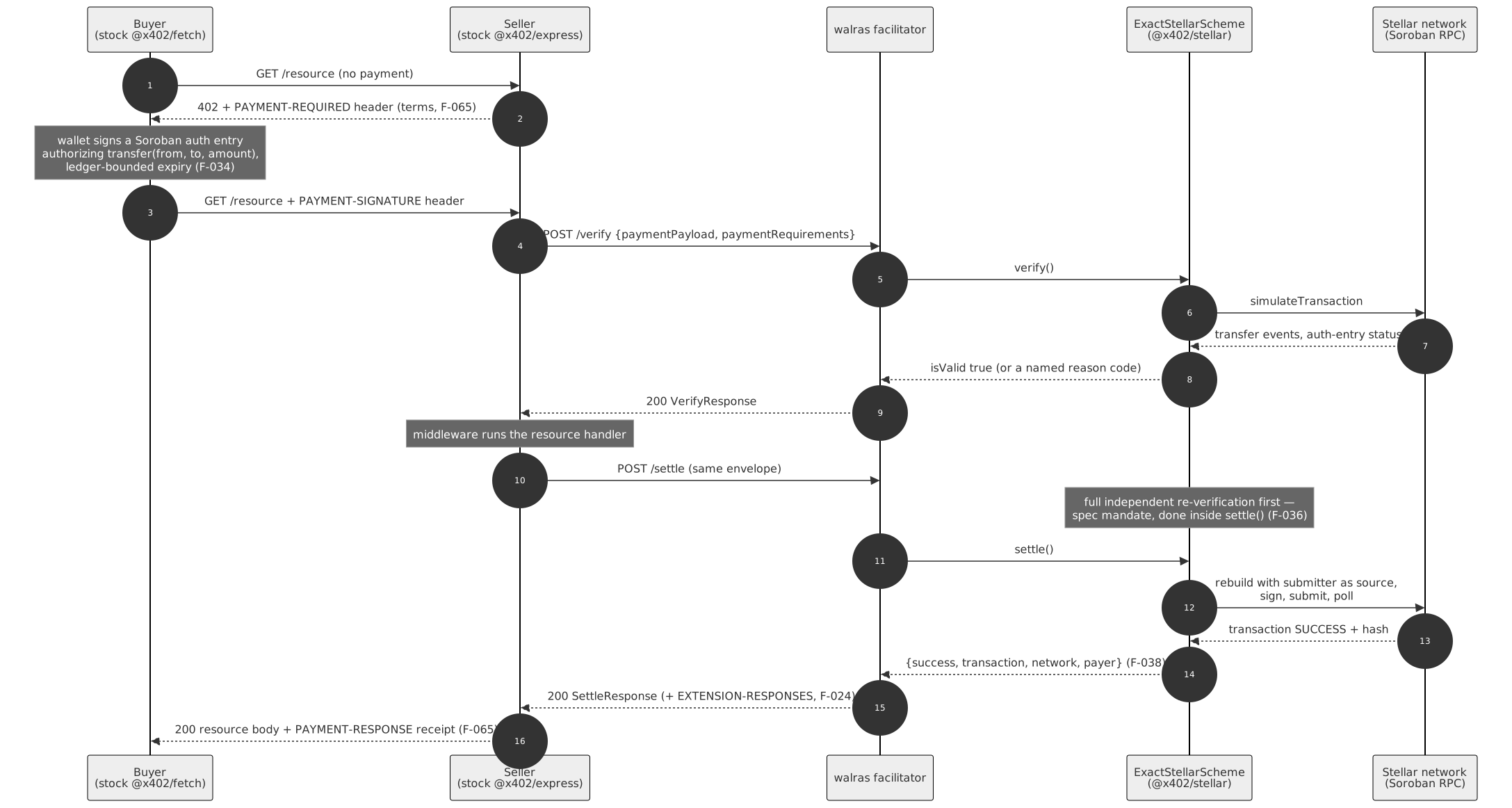
Source: diagrams/payment-settlement-sequence.mmd.
The full wire transcript of exactly this flow, stock client on both sides, is
S2-2.
Step by step, with the load-bearing facts:
- The buyer's first request carries no payment; the seller answers 402 with terms
in the
PAYMENT-REQUIREDheader — the v2 canonical name, notX-PAYMENT(F-065). - The buyer's wallet signs a Soroban auth entry authorizing exactly
transfer(from, to, amount)on the asset contract — not a pre-signed transaction (F-033). Validity is ledger-bounded, derived frommaxTimeoutSeconds(F-034). - The seller's middleware POSTs
{paymentPayload, paymentRequirements}to/verify. The scheme checks protocol, transaction structure, arguments, simulation, transfer events, auth entries, and facilitator safety — in that order, with simulation as the gate for the auth-entry and event checks (F-035, F-064). - On
isValid: truethe seller executes the resource, then POSTs the same envelope to/settle. walras runs no wrapper-level pre-verify: the spec requires settle to verify independently and the scheme'ssettle()already does so as its first step (F-036) — a wrapper pre-verify would double every simulation and add no safety. - The scheme rebuilds the transaction with a walras submitter as source (the buyer's
signed auth entry rides along), signs, submits, and polls. The receipt is
{success, transaction, network, payer}with the 64-hex on-chain hash (F-038). - Fees: the submitter sponsors the network fee — the buyer needs only the payment asset
(F-006). Measured on
stellar:testnet: 22 973 stroops per settlement on the single-submitter path (F-069, S2-3), 23 073 on the fee-bump path (F-086, S7-1).
HTTP status convention: a payment the scheme rejects is a 200 carrying
isValid: false / success: false — a successful exchange about an invalid payment,
matching the reference facilitator. 4xx is reserved for requests that could not be
interpreted as an x402 exchange at all, and even those are rendered in the protocol
shape so the stock client's error path keeps the machine-readable code (§3.4).
3.3 Error model
Two disjoint taxonomies, enumerated in src/errors.ts (DECISIONS D-007) and rendered
into reference/errors.md by the generator:
- 37 inherited codes from
@x402/stellar, passed through verbatim, never shadowed. - 10
walras_*codes covering only what the package is silent about: envelope validation, kind routing, discovery query interpretation, unknown routes, wrapper faults.
The package populates a human-readable message on exactly one of its paths, so walras backfills the rest — the code is never rewritten, only the message is filled in. That is what makes RFP 3.6's "non-null reason on every rejection" true by construction rather than by assertion. A test greps the installed package bundle for reason-code literals and fails if the set differs from the enumeration (F-063) — drift, not inability, is this project's failure mode (F-061).
3.4 Configuration
Generated from the in-code CONFIG_REFERENCE tables:
reference/config.md. Two properties worth naming here:
- Invalid configuration exits with
EX_CONFIG(78) before a port is bound. A facilitator that starts on half-valid configuration advertises capability it cannot honour. FEE_MODEgoverns the service fee (onlyfreeis implemented; anything else is a startup error). It is distinct fromextra.areFeesSponsored, which is about network fees and is alwaystruebecause the scheme always sponsors them (F-006).
3.5 /supported
Served straight from x402Facilitator.getSupported(): kinds, extensions, and
signers, all three required (F-040). The Stellar kind carries
extra.areFeesSponsored: true, byte-identical to the x402.org baseline capture for
stellar:testnet (F-041, S0-2) — asserted against the captured value in
test/supported.test.ts. extensions lists bazaar because the discovery endpoints
are mounted and reachable; it was an empty array until they were (D-016 — advertised
support and reachable support must never diverge, in either direction).
4. The indexing invariant: cataloging never blocks settlement
The settle response is produced from the chain result alone. The indexing hook runs after the settlement outcome is decided, and nothing it does can change that outcome (DECISIONS D-015):
- The indexer never throws by contract; a belt-and-braces catch in the route holds the invariant even against a bug in the hook glue itself.
- Its work is structurally bounded: a 64 KiB cap on the extensions block before any validation touches it, and a 100 ms database busy timeout — that is how the "small budget" is enforced rather than promised (D-025). A soft 250 ms budget makes violations visible in logs without preempting anything.
- Its outcome only ever decorates the response with the
EXTENSION-RESPONSESheader (F-024):success, orrejectedwith a humanrejectedReasonplus an additive machinecode(D-014). An internal indexer fault omits the header entirely — a walras bug is never reported as a client defect (D-025). - A forced-failure test pins it: settlement succeeds while the catalog store is broken (the D-015 test in the facilitator suite).
The lifecycle, end to end:

Source: diagrams/payment-lifecycle-state.mmd
5. Throughput design
As built (S2-3, S5-2): on the single-submitter path one account sources each
settlement, source_account == fee_account, charging 22 973 stroops (F-069). With a
fee-bump signer configured (S7-1) fee_account ≠ source_account and the charge
is 23 073 stroops (F-086).
The scale-out path is configuration, not engineering, because the package already ships it (D-012):
SUBMITTER_SECRETaccepts a comma-separated list; multiple submitters run under the package's round-robin signer selection (F-044).FEE_BUMP_SECRETwraps each settlement in a fee-bump transaction, decoupling fee payment from sequence-number management (F-047). The reference operator runs exactly this posture in production — its settlements showsource_account ≠ fee_account(F-055). Captured live for walras itself (S7-1): five settlements through the fee-bump path,fee_account ≠ source_accountverified on Horizon, fee 23 073 stroops — exactly the D-021 delta of 100 stroops over the single-submitter posture, and byte-matching the baseline's fee anatomy (F-054).
PLANNED (RFP 3.5, grant scope): a managed channel-account pool — pre-created submitter accounts sized to observed load, health-checked, rotated on sequence contention — plus load-shedding rules. The design intent is that bursty agent traffic never queues on one sequence number; the pre-build demonstrates the mechanism (multi-signer round-robin + fee-bump) without the pool manager.
6. Deployment topologies

Source: diagrams/deployment-topologies.mmd
6.1 Hosted
One operator runs walras for many sellers; the shared catalog is the point — every seller that settles through the instance becomes discoverable to every buyer that queries it (D-004). This is the topology every evidence transcript runs. The hosted instance is operated by us; nothing about the protocol privileges it (§6.2).
6.2 Self-hosted
The same code, run by anyone: git clone, set SUBMITTER_SECRET, start
(runbook.md). Apache-2.0 with a copyleft-free dependency path
(F-060, D-031) is what makes this real rather than nominal — the RFP's "the ecosystem
must not depend on a single hosted operator" is satisfied by the license and the
runbook, not by a promise. A self-hosted instance catalogs what settles through it;
federation across catalogs is PLANNED (interop direction, not yet designed in
detail).
6.3 Self-facilitation inside a resource server — PLANNED
RFP 3.1 asks for the facilitator to be embeddable next to the routes it serves, no
separate process. The seam exists as built — buildServer takes injected config and
store, and the tests drive the whole app in-process through inject with no socket —
but no packaged embedding mode ships in the pre-build. PLANNED: an exported
createSelfFacilitatingMiddleware (working name) that mounts verify/settle/discovery
inside an Express/Fastify resource server, sharing the catalog store.
7. Discovery layer (packages/bazaar)
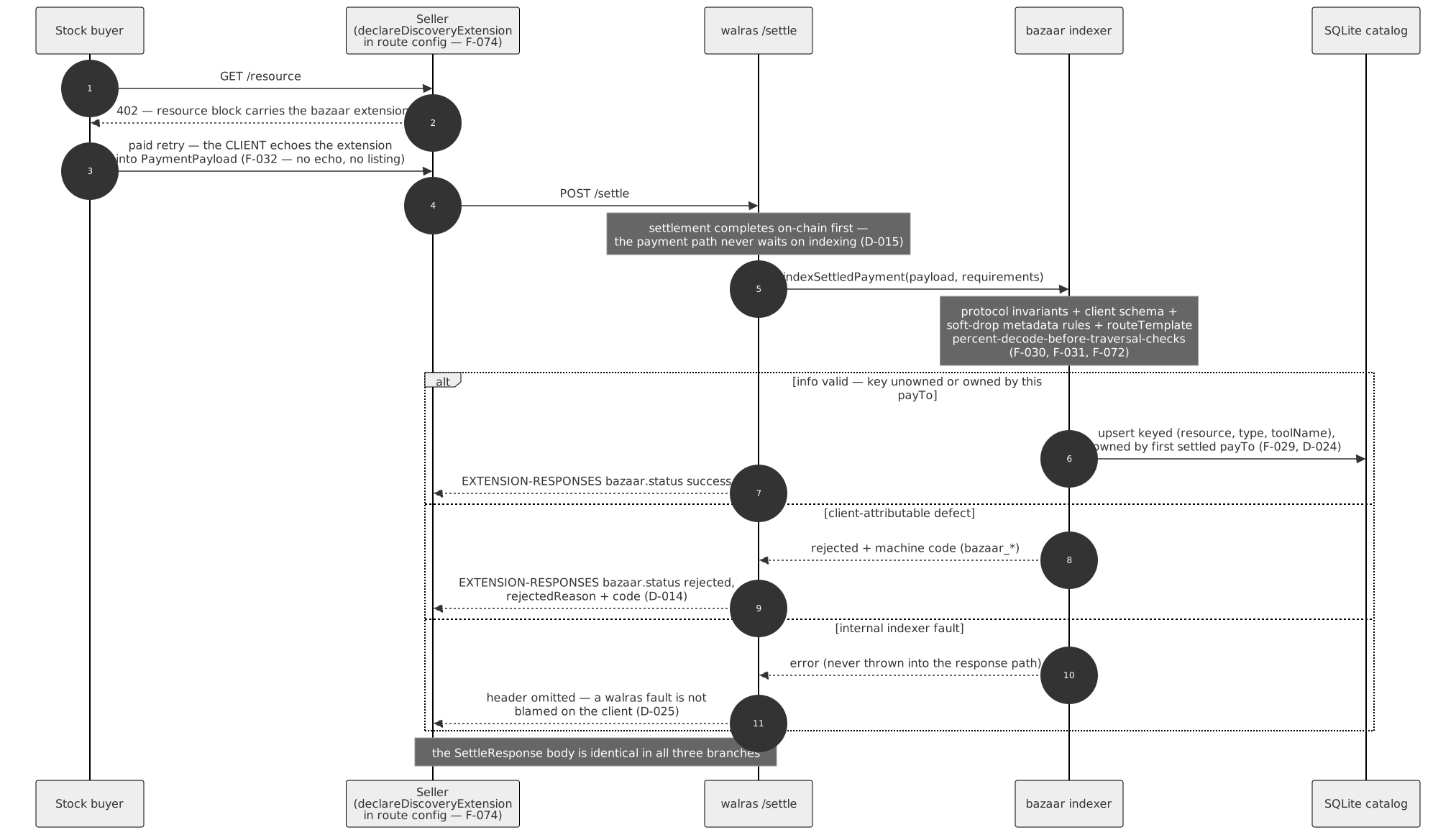
Source: diagrams/auto-catalog-sequence.mmd.
Proven live: S3-3 (pay → listed, zero registration), S3-4 (hostile writes
soft-dropped while their settlements succeeded).
Three layers, deliberately transport-free:
- store — SQLite via Node's built-in
node:sqlite(WAL, zero added dependencies; D-023). Listings are keyed on(resource, type, toolName)per the spec's MCP tuple MUST (F-029) and owned by the first settledpayTo(D-024). Schema ERD:diagrams/catalog-erd.svg— generated from the DDL. - indexer — the trust boundary. Everything echoed by the client is hostile until validated (F-072); every rejection carries a machine code; an indexer fault can degrade discovery but never a settlement (§4).
- wire — mapping to the stock SDK's
DiscoveryResourceshape and theEXTENSION-RESPONSESheader (F-024, F-050).lastUpdatedis the ISO 8601 string the SDK type declares, not the v2 spec's conflicting Unix-number example (D-002).

Cataloging is settle-gated: a listing exists because a payment settled on-chain through walras. That is a deliberate anti-spam policy, not spec conformance (F-023, D-004), and it is why there is no registration endpoint at all (D-022).
8. Search (GET /discovery/search)
Spec-shaped end to end (F-026 … F-028): required query parameter (never q, D-006),
the same five filters as the list endpoint, a resources array (never items, D-001),
an explicit partialResults, and real keyset cursor pagination — deliberate
over-delivery against the spec's advisory MAY, per D-003; no reference operator
implements it (F-013).
The pipeline: a Retriever ranks catalog rows for the query; the shared filter
semantics intersect that ranking; the cursor slices it. Retriever is a one-method seam
(query → ranked ids + scores), so ranking improvements never touch the wire contract,
the filters, or pagination.
8.1 BASELINE retriever
The pre-build ships exactly one retriever, labeled BASELINE (D-026): SQLite FTS5 with
BM25 over four weighted fields — service name (4.0), description (2.0), parameter
text (1.0), tags (3.0); weights are rule-of-thumb, explicitly untuned. Parameter text is
parameter names plus JSON-Schema description annotations; example values are
deliberately not indexed (an example city of "Zurich" says nothing about what a resource
does). Untrusted queries are compiled to quoted-token OR expressions, since raw FTS5
syntax throws (F-076). There is no stemming, no stopword handling, no synonym
expansion — and the eval set contains queries chosen to fail on exactly those gaps.
8.2 Evaluation harness
pnpm eval:search builds a fixture catalog from eval/search/corpus.json through the
production indexing path, runs the 28 labeled queries in eval/search/queries.json,
and reports recall@1/3/5, MRR@10, and nDCG@5/10. Baseline numbers are recorded in
S4-3 (recall@5 0.93, MRR@10 0.91). This harness is the answer to "how will you
evaluate result quality over time": a ranking change is graded by re-running one command
and diffing numbers, never by eyeballing results.
8.3 Ranking upgrade path — PLANNED (grant scope)
In measurement order, each step landing only if it moves the harness's numbers: lexical hygiene (stopwords, light stemming) → hybrid retrieval (BM25 fused with dense embeddings computed at index time, reciprocal-rank fusion first) → cross-encoder re-ranking over the fused top-k. The vocabulary-gap queries that score zero today are the acceptance tests for the second step.
9. MCP server (packages/mcp-server)

Source: diagrams/discovery-agent-flow.mmd.
Proven live with a generic MCP client carrying zero walras imports: S6-3 —
including paying a live MCP tool whose own settlement auto-cataloged it.
Two tools over stdio, and the whole discover→pay loop behind them (F-080 — the tools,
the bridge, and catalog resolution are entirely this repository's build; @x402/mcp
supplies only the payment-aware client and the server-side wrapper):
search_resources— ranked catalog search via the facilitator's/discovery/search. Each hit carries a deterministic, self-describing id (wr1:+ base64url of the listing tuple, D-029), price in base units, network, and the machine-readable calling convention (F-082).paid_call— resolves the target (by id against the live catalog, or by url + toolName), probes its live 402, applies the spend policy, and pays through the stock client path. The cap binds twice: a pre-payment check and aregisterPolicyfilter on the one sharedx402Client, so no transport can bypass it (F-081, D-030).
Every failure on every path is a structured {errorCode, reason} tool result —
facilitator codes pass through verbatim, walras_mcp_* codes cover only this server's
own surface, and results are dual-format (structured content + identical JSON text) per
the MCP transport spec's rule (F-079, D-028).
10. Testing strategy
Tests drive the Fastify app through inject (no socket) and the MCP server through
real in-memory MCP transports (S6-2); configuration is passed explicitly, so the suite
needs no .env and no secrets. Workspace total after the docs session: 213 tests
(bazaar 64, facilitator 99, mcp-server 50).
The route schemas attached in server.ts are documentation-grade: no-op validator and
serializer compilers keep runtime behavior identical to a schema-less app (no Ajv
coercion, no fast-json-stringify field dropping), which the behavioral suite pins.
10.1 The Soroban RPC double
test/helpers/soroban-rpc-double.ts is an in-process JSON-RPC server. It exists
because of an ordering fact: the scheme reaches its auth-entry and transfer-event
checks only after simulation succeeds (F-064), so those codes are unreachable
against a live network in a hermetic suite. The double verifies auth-entry signatures
for real (Ed25519 over the CAP-46 preimage) and synthesizes transfer events from the
transaction actually submitted; it is not a Soroban VM — no balances, no footprints,
no nonce consumption. Results obtained through it are modelled, not observed
on-chain, and are labelled that way in evidence (D-017). Live S2 replays confirmed
its predictions exactly where the two overlap (D-017 follow-up).
10.2 Fixtures
packages/facilitator/test/fixtures/exact-stellar.json, regenerated by
node scripts/build-fixtures.mjs. The transactions are synthesized, not captured —
keys are real, signatures verify against the real preimage, the XDR is real; the
assembly is local, and none has been submitted to a network. The facilitator identity
in fixtures is a disposable account so the suite runs in CI without secrets.
11. Documentation pipeline
Generated-over-transcribed (writing rule R3): pnpm docs:gen regenerates
api/openapi.yaml from the Fastify route schemas,
reference/config.md from the CONFIG_REFERENCE tables,
reference/errors.md from the error enumerations, the catalog
ERD from the store's DDL, and re-renders any diagram whose SVG is stale (source-hash
markers, rule R6). pnpm docs:check fails CI on generator drift, invalid OpenAPI,
stale SVGs, dead links, banned words, uncited capability claims, and dated roadmap
items. Docs tooling licenses were pre-checked before install (F-084); the license gate
is two-tier per D-031.